Artificial Kinetic Intelligence
“For a true Artificial Superintelligence, a global AKI infrastructure is not just an optional add-on;”
“It Is Critical”
WHAT IS AKI?
-
- Artificial Kinetic Intelligence (AKI)
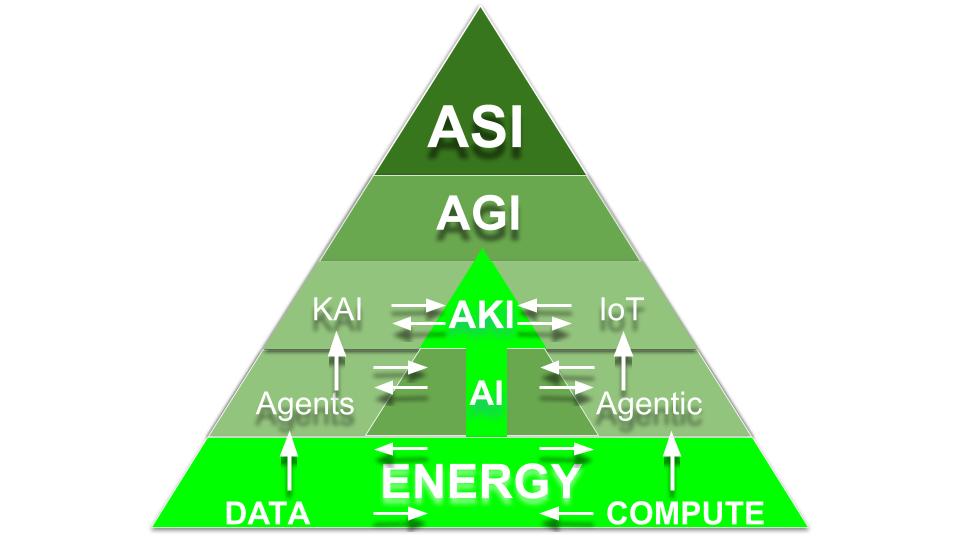
- AKI is Physical AI and AI Energy in one
- True AGI Requires deep adoption of AKI.
- AKI is Non-Negotiable layer for AI
- AGI /ASI cannot exist without AKI
- Artificial Kinetic Intelligence (AKI)
-
- AKI bridge’s the “Energy and Data gap” that currently limits AI Capability. AKI enables Physical AI’s reach into remote and dynamic environments worldwide.
What IS PHYSICAL AI?
Physical AI is where AI goes beyond generative software and starts interpreting the real world. AKI is an extension to Physical AI embedded in machines like robots, autonomous vehicles, and drones. Unlike generative AI that produces on-screen digital content, physical AI performs physical work by interacting with the environment through sensors and actuators under real-world constraints.
IS AKI PHYSICAL AI?
Physical AI is limited to rely on an energy source to power sensors, actuators and IoT. AKI provides an intelligent energy source that enables Physical AI ground truth in a unified system. AKI operates independently of robots, autonomous vehicles, and drones. With an AKI infrastructure, energy becomes a secondary concern and the primary aim is to establish GGI to support an AI digital twin of the world.
Why is AKI important FOR AI?
- AKI provides a new frontier in Kinetic-Powered Geospatial Intelligence.
- AKI reduces AI Energy Dependence and increases Accessible Information layers.
“By converting ambient motion into actionable data, An AKI platform generates a live ‘kinetic twin’ of the physical world.”
—–
- Layer 1: Advanced Kinetic Induction (Mechanical)
The physical hardware layer. A pendulum-like electromagnetic induction system that harvests energy from subtle vibrations, waves, or mechanical stress. Unlike piezoelectric systems, it is engineered for decadal durability.
- Layer 2: Autonomous Kinetic Intelligence (Edge)
The decentralized “nodes.” These battery-less peripherals operate with 100% uptime, performing local “Environmental Machine Learning” to filter and process kinetic signatures before transmission.
- Layer 3: Advanced Kinetic Information (Data)
The raw output. The AMO Signature provides a “physical truth” signal. Fast, slow, or vibrational oscillations are hardcoded into the magnetic pulse, making the data virtually impossible to spoof.
- Layer 4: Artificial Kinetic Intelligence (Systemic)
The “Global Nervous System.” The central ASI integrates trillions of AKI data points to create a real-time Kinetic Digital Twin of the planet, enabling predictive maintenance and autonomous governance.
—–
WHAT IS AI WITHOUT ENERGY AND DATA?
A lack of energy or data limits current AI. The AKI infrastructure enables Autonomous Conversion of Kinetic Activity to Electromagnetic induction and raw data transmitted via IoT. The Telemetric-like layer; By bridging AI’s energy and data into logic from the physical world, eliminating the need for chemical batteries or grid dependency, these peripherals maintain 100% uptime, transmitting high-fidelity physical data from high-motion zones (such as subsea, industrial vibration sites or roads) directly to the cloud via self-sustaining IoT protocols.
—–
Is Artificial General Intelligence (AGI) Similar to PGI and GPI?
While Artificial General Intelligence (AGI) is often defined as a machine’s ability to perform any intellectual task a human can, it remains fundamentally limited if it lacks a physical interface with reality. The question is not whether a machine can think. The question is whether a machine can know — in the way that a body knows, through direct physical contact with reality rather than through the accumulated residue of human description. To bridge this gap, we must distinguish between abstract logic and embodied intelligence.
The Data Gap: Standard AI relies on Informational Data — predefined, static datasets derived from human-driven content. In contrast, Physical General Intelligence (PGI) and General Physical Intelligence (GPI) require Physical Conditional Data. This is real-time, responsive feedback derived from direct interaction with environmental variables such as gravity, friction, and resistance.
The Temporal Gap: Standard AGI operates on historical inference — its knowledge of the world is always a reflection of the past, filtered through human documentation. PGI and GPI operate in physical present tense. Because AKI sensors respond to environmental perturbation in real time, the intelligence they feed is not reasoning about what the world was — it is reasoning about what the world is, at the moment of inference. This distinction between retrospective and present-tense intelligence is not incremental. It is categorical.
The AKI Synthesis: Artificial Kinetic Intelligence (AKI) serves as the unifying bridge between these pillars. By providing a system with Autonomous Proprioceptive Inference, AKI enables AI to “feel” its environment through the Active Magnetic Oscillation (AMO) signature. This transforms the AI from a passive observer into an embodied participant, allowing it to adapt to physical constraints in real-time — a capability known as Zero-Shot Physical Adaptation.
—–
The AKI Inference Loop:
From Human Content to Planetary Context
The true separation between current AI, Physical AI and AGI lies in the Inference Loop. Existing models are restricted by recursive learning on human-generated data, which is inherently fragmented, delayed and bound by energy dependancy. AKI introduces a reasoning factor based on a global scope of physical changes that is too vast for human encapsulation and would increase the energy demand beyond the available limits.
Planetary-Scale Reasoning: Currently, analysing global physical shifts requires isolated groups of human specialists to aggregate nuggets of data from specific timeframes to form a static historical snapshot. An AGI utilising AKI removes this bottleneck by integrating a planetary scale of physical information into a single, live dataset.
Unbiased Physical Truth: Human-generated datasets carry the accumulated biases, gaps, and distortions of human perception and documentation. Physical data derived from AMO induction signatures carries none of these biases. Gravity does not have an agenda. Friction does not have a political position. Resistance does not reflect cultural assumptions. By grounding AGI inference in physical conditional data, AKI introduces the first genuinely objective data source available to machine intelligence — one governed entirely by immutable natural law rather than human interpretation.
Autonomous Cause-and-Effect Mapping: By inferencing major changes across global datasets, AKI develops a live, autonomous Cause-and-Effect map. The system moves beyond simple pattern recognition to true reasoning — granulating the difference between anticipated physical changes (habitual patterns) and unexpected anomalies.
Predictive Physical Modelling: Because AKI establishes a continuous, planetary-scale baseline of normal kinetic behaviour — across oceans, urban infrastructure, biological movement, and geological activity — the AGI can develop what might be termed a Physical Prior: a probabilistic model of how the planet habitually behaves. Deviations from this prior, detected across the mesh in real time, provide a predictive horizon that no reactive sensor system can match. The AGI does not wait for an event to occur and then respond. It detects the precursor signature — the anomaly in the kinetic baseline — before the event fully manifests.
Real-Time Anomaly Detection: This level of reasoning enables the AGI to detect and react to instantaneous global events, such as:
- Tectonic and Celestial Events: Detecting unexpected tidal patterns from tectonic shifts or oceanic impacts (e.g., asteroid landings) before classical sensors might process the scale.
- Biological Signals: Monitoring mass instinctual animal migrations across remote terrains via global kinetic sensors.
- Human Societal Patterns: Identifying traffic and migration anomalies caused by a combination of habitual patterns and unexpected monthly events.
- Critical Infrastructure Integrity: Bridges, dams, pipelines, and urban foundations all exhibit characteristic kinetic signatures under normal load conditions. AKI sensors embedded in or adjacent to these structures continuously monitor their vibrational profile. Structural fatigue, ground subsidence, or sudden stress events produce anomalous signatures detectable across the mesh before catastrophic failure occurs. This moves infrastructure safety from periodic human inspection to continuous autonomous awareness — with no power dependency on the grid the infrastructure itself serves.
- Oceanic Climate Precursors: The ocean’s kinetic behaviour — wave frequency, swell pattern, current interaction — encodes atmospheric and climatic information that currently requires satellite observation and human analysis to interpret. An AKI mesh operating across ocean surface and subsea environments provides a continuous, unmediated reading of these patterns at a resolution no satellite can match. Climate anomalies, storm precursor signatures, and oceanic thermal events become visible in the kinetic data before they manifest at the surface — giving the AGI a predictive window into atmospheric events that current early warning systems cannot access.
—–
AGI vs. AGI + AKI (PGI): At a Glance
| Capability | Current AGI | AGI + AKI (PGI) |
|---|---|---|
| Data source | Human-generated, historical | Physical, real-time |
| Energy dependency | Grid-dependent | Energy-sovereign |
| Temporal awareness | Retrospective | Present-tense |
| Bias exposure | High — human filtered | Minimal — physics governed |
| Anomaly detection | Reactive | Predictive |
| Global coverage | 29% of Earth’s surface | 100% uptime, all terrains |
| Uptime | Grid-dependent | Indestructible |
—–
By shifting the foundation of AGI from human-driven content to a global physical nervous system, we enable a form of reasoning that doesn’t just simulate human thought, but anticipates the deterministic behaviour of the planet itself. This is the threshold between Artificial General Intelligence and Physical General Intelligence — between a system that knows about the world and a system that knows the world.
AKI is not the final step in that transition. It is the first step that makes all subsequent steps possible. Without it, AGI remains a mirror reflecting human knowledge back at itself. With it, intelligence becomes genuinely planetary — grounded, sovereign, and alive to the physical pulse of the world it inhabits.
These layers, allow for precise monitoring of smart city traffic flows, tectonic shifts, or oceanic conditions, etc, providing a level of real-time spatial awareness previously impossible with battery-constrained remote sensing.
—–
Why is this a Global advantage?
At the core this system implicates a critical AI layer; the Global Distributed Positioning Autonomous Kinetic Intelligence (GDP AKI), a mesh network of synchronised sensors that map environmental kinetic energy patterns. This GDP AKI framework allows the central AI to process real-time mechanical and environmental fluctuations across vast distances, enabling predictive modelling that adapts to physical changes as they occur.
Artificial Kinetic Intelligence (AKI)
Environmental sensing & energy management – Kinetic harvesting; battery-less IoT; remote environmental data.
Kinesthetic AI
Robotic motor skills – Learning-by-doing; mimicking human/animal locomotion.
Kinetic AI (Cyber-Kinetic)
Security & Defence – Protecting physical infrastructure from digital/kinetic hybrid attacks.
Active Kinetic 1 have developed the physical architecture to effortlessly facilitate remote battery-less sensors that can feedback data via the cloud to AI. AKI is a paradigm shift, the adoption of AKI will become an enabler for true AGI, it is profound and transforms remote sensory feedback in robotics development. AKI enables superior AI capabilities by providing global remote feedback from a variety of terrains, far outweighing AI’s current access to physical data.
Long description: AKI typically provides core advantages for Artificial Intelligence:
Autonomous Global Environmental Technological Awareness: object movement, perturbation, manipulation, or any physical interaction in contact with AKI device acting as a “True Passive sensor“ that can interact using IoT to feedback via the cloud services. Gathering real-time data at a distance resulting in AGI awareness. Active Kinetic 1 Kinetic Energy Harvesters are scientifically proven devices that produce unique electromagnetic wave patterns. These patterns are used in real-world AKI technologies such as moving magnetic materials, interacting with electromagnetic coils which provides feedback via neural IoT interfaces to transmit data via the cloud providing AI a physical nervous system. There are other technologies that achieve similar effects, however they lack essential physical capability or are dependant on batteries or permanent energy constraints. AKI is a unique area of Artificial Intelligence currently under investigation and development by Active Kinetic 1 which alleviates energy constraints, while elevating high-fidelity physical data.
The TRADITIONAL AI Model
In AI development, the “layers” are typically referred to as the :Training Phase” and the “Inference Phase” (or Deployment Phase).
THE TRAINING PHASE:
The process of repeating the learning to reduce parameters for faster interaction is called Model Optimization or Model Compression.
The initial stage is where a “heavy” model is created:
High Complexity: The model is built with millions or billions of parameters (weights and biases) to ensure it can capture complex patterns in data.
Dense Learning: This uses significant computing power (GPUs) to adjust these parameters through thousands of iterations until it reaches high accuracy.
THE OPTIMIZATION PHASE:
Once the model is trained, it is often too large to run quickly on a phone or a standard web server.
Developers use several techniques to “shrink” it:
Pruning: This identifies and removes “superfluous” connections or neurons that don’t contribute much to the final result, making the network “sparser”.
Quantization: This reduces the precision of the numbers used. For example, instead of using highly detailed 32-bit numbers, the model is converted to use 8-bit integers, which are much faster for hardware to process.
Knowledge Distillation: A large, “teacher” model trains a much smaller, “student” model to mimic its behavior, effectively transferring its knowledge into a more efficient package.
THE INFERENCE PHASE:
This is the final “layer” where the optimized model interacts with the real world.
Speed and Efficiency: Because the number of parameters and their precision have been reduced, the model can now provide answers (inference) almost instantly with much less memory.
Real-Time Interaction: This is the version of the AI you interact with in apps or chatbots.
AKI Interjects Recursive Learning
- Artificial Kinetic Intelligence (AKI)
- Autonomous Kinetic Intelligence
- Advanced Kinetic Information
In a standard AI model, data passes through unique layers (Layer 1, Layer 2, Layer 3).
In a Recursive Model, the “layers” shift from being a vertical stack of different unique functions to a horizontal loop of the same function applied over and over.
The AKI Recursive Model further extends this loop. New learning no longer just sits “on top” of a base model; it integrates through Continuous Improvement Loops in phases in each layer.
- Self-Awareness (The “Saddle”): Learning from changes in conditions “saddles” the base model during inference through Self-Refinement and Self-Correction.
- Synthetic Feedback Loops: As new data is “interjected” the model generates its own training examples. It solves by identifying new patterns. While the base layer remains unchanged, it uses those patterns to fine-tune the base weights for the next generation.
- The “Distillation” Layer: Often, a giant base model (the “Teacher”) creates high-quality data that is fed into the smaller recursive model (the “Student”). This “accompanies” the base model by allowing the smaller model to inherit complex reasoning without the massive parameter count from millions of patterns. Where it struggles to match patterns or there is a pattern sort failure the data is rejected and gains a negative weight.