
EXPERIENCE THE FIELD: THE ACTIVE MAGNETIC CRADLE & SENSOR SUITE
The principles of Artificial Kinetic Intelligence are no longer confined to laboratory testing. The core physics of Active Magnetic Oscillation are now observable, verifiable in real time, and primed to reinforce the next generation of Physical AI.
Our upcoming smartphone application demonstrates a foundational leap in physical sensing, enabling developers, researchers, and tech enthusiasts to turn any standard smartphone into a 100 Hz high-fidelity magnetic scope. By placing a mobile device adjacent to the desktop Active Magnetic Cradle, users can directly observe carrier frequency locking, real-time multi-axis flux partitioning, and kinetic perturbation ringdown right on their screen.
Stay tuned for the public release of the companion application and our forthcoming desktop hardware launch.
1. OVERVIEW OF ARTIFICIAL KINETIC INTELLIGENCE (AKI)?
Artificial Kinetic Intelligence (AKI) is a specialized AI framework designed to operate at the direct convergence of the physical universe, machine learning, and thermodynamics. While this foundational intersection remains central, ongoing advancements establish AKI as the vital bridge unifying Physical AI, autonomous kinetic energy harvesting, and field-mediated computation. Unlike traditional generative digital models that process historical, static data (such as offline text or captured images), AKI operates continuously in the physical present tense.
Core Attributes
- Physical AI: AKI operates directly within the physical universe—converting mechanical motion, environmental vibrations, and magnetic flux into real-time computational work.
- Energy-Data Synthesis: It simultaneously manages continuous data processing and ambient physical energy conversion within a single operational loop.
- Kinetic Harvesting: It dynamically converts mechanical and kinetic environmental energy into usable electrical power, eliminating the need for periodic battery replacement.
- Zero-Shot Physical Adaptation: It empowers physical systems (such as robotics and autonomous platforms) to adapt instantaneously to unpredictable real-world forces—including sudden shifts in gravity, surface friction, or terrain gradients—without prior training or offline simulation.
Current artificial intelligence architectures face a severe double bottleneck: exponential electrical power consumption running power grids dry, and an inability to perceive unbiased real-world dynamics. AKI resolves this crisis. By utilizing the deterministic dynamics of Active Magnetic Oscillation (AMO), AKI establishes a self-powered, clockless physical nervous system that connects autonomous machines directly with the kinetic reality of their operational environments.
2. WHY IS AKI IMPORTANT FOR AI?
True autonomy cannot exist if an intelligent machine is severed from physical ground reality. AKI provides three vital capabilities required for the next evolution of intelligent systems:
Key Capabilities
- Kinetic-Powered Geospatial Intelligence: Enables persistent, battery-free edge monitoring across remote, GPS-denied, or subsea environments where physical battery maintenance is impossible.
- Decoupled Energy Dependence: By converting ambient mechanical oscillations directly into usable electrical potential and computational states, AKI allows edge nodes to operate with 100% continuous uptime.
- Zero-Shot Physical Adaptation: Real-time mechanical feedback allows autonomous robotics and platforms to perceive changes in structural mass, friction, and environmental loading instantly, adapting motor control policies without retraining cloud neural networks.
Artificial Kinetic Intelligence serves as an authoritative, non-negotiable substrate layer for advanced AI architectures. It addresses the physical realities of computing, zero-energy environmental awareness, planetary-scale deployment across multiple domains, and the necessity of unified communication protocols for asset coherence.
3. AKI IS NO LONGER CLASSIFIED AS ARTIFICIAL NARROW INTELLIGENCE (ANI)
The operational principles of Artificial Kinetic Intelligence have expanded far beyond the constraints of Narrow AI. Because the core physics of Active Magnetic Oscillation are now observable and verifiable in real time, AKI field computing directly accelerates embodied machine intelligence, causing the traditional boundary lines of Artificial Narrow Intelligence (ANI) to blur and dissolve.
Earlier iterations of kinetic monitoring were often categorized under ANI due to their focused mechanical scope. However, the introduction of non-linear state mapping, recursive self-optimization, and clockless temporal logic elevates AKI into Embodied Physical General Intelligence (PGI).
The Pillars of Embodied PGI
- Universally Grounded Domain: While AKI does not generate text or trade financial markets, it is universally grounded in the governing laws of classical mechanics, non-linear dynamics, and electromagnetism. It serves as the physical nervous system for all automation.
- Autonomous Adaptation & Self-Optimization: AKI is not a static sensor. Through adaptive damping analysis and physical state recovery, the system evaluates its own kinetic dissipation in real time, optimizing internal parameters and predicting environmental anomalies autonomously.
- Continuous State Landscapes: Rather than executing rigid binary instructions, AKI maintains continuous, multi-dimensional Hamiltonian state spaces. It resolves complex physical interactions natively through the dynamic motion of the cradle substrate itself.
4. IS AKI PHYSICAL AI?
Yes, but with a foundational architectural leap. Conventional Physical AI relies on chemical batteries or constant grid connections to power sensors, microcontrollers, and mechanical actuators. When power fails or batteries degrade, conventional Physical AI ceases to operate.
AKI unifies power, perception, and computation into a single physical substrate:
Substrate Integration
- Kinetic Autonomy: Eliminates reliance on external power grids. Ambient motion—such as ocean swells, structural vibrations, or mechanical movement—drives the system indefinitely with near-zero static power leakage.
- Field-Mediated Processing: Rather than forcing continuous physical signals through power-hungry analog-to-digital converters and silicon processors, AKI utilizes continuous magnetic flux compression and non-linear mechanics as a physical reservoir computer, processing dynamic states at the speed of electromagnetic induction.
- Sovereign Ground Truth: AKI operates independently within physical infrastructure, robotics, and maritime environments, generating uncorrupted environmental telemetry that cannot be spoofed or biased by digital generation.
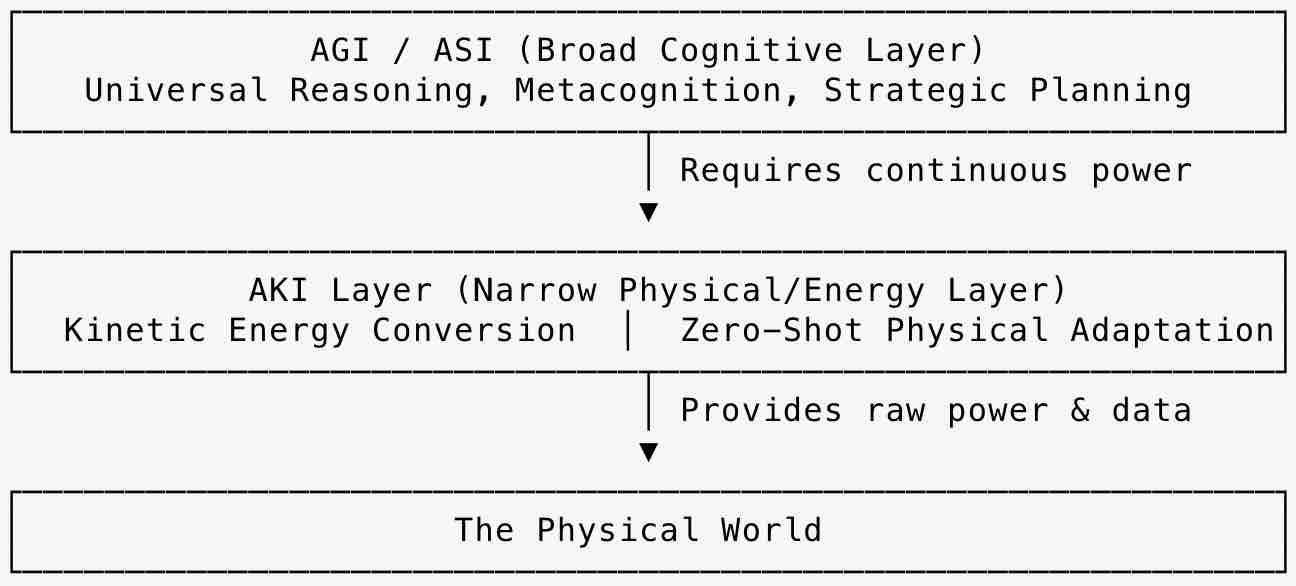
5. THE ARCHITECTURE: WHY AGI/ASI REQUIRES AKI
A common question in computer science is: If AGI or ASI possesses universal superintelligence, why can it not simply do without AKI?
The answer lies in the boundary between software (intelligence) and substrate (the physical medium required to run it). No software can exist without physical electrons.
The Non-Negotiable Bottlenecks
- A. The Energy Bottleneck: Current AI scaling models require immense electrical grids to function. An AGI or ASI cannot be truly autonomous if it is tethered to a static power grid. AKI provides the thermodynamic loop needed for an autonomous system to harvest its own operational energy directly from its physical movement and environment.
- B. The Grounding Bottleneck: True intelligence requires an understanding of cause and effect in reality. If an AI only learns from digital datasets, its understanding is simulated. AKI acts as the “nervous system,” grounding the AI’s cognitive layers in the immediate, unsimulated laws of physics.
6. THE PHYSICS SUBSTRATE: WHY AKI IS AUTHORITATIVE
Every artificial intelligence system—whether standard silicon, quantum computing, or biomorphic processors—is ultimately bound by the laws of physics. Intelligence cannot exist without a physical medium.
Foundations of Physical Authority
- The Undetachable Electron Substrate: Digital code, neural network weights, and quantum superpositions are not abstract concepts; they are the physical manipulation of electrons, photons, or quantum states. This physical substrate requires a continuous, precise flow of energy.
- The Vulnerability of Standard AGI: An AGI system running without an integrated physical layer is intrinsically vulnerable. If its external grid or battery fails, the system ceases to exist.
- The AKI Resolution: By anchoring an AI directly to AKI hardware—such as Active Kinetic 1’s Active Magnetic Oscillation (AMO) mechanics—the software layer gains authority over its own physical state. The intelligence controls the very mechanism that harvests and regulates the electrons keeping it alive.
7. ZERO-ENERGY ENVIRONMENTAL AWARENESS
Traditional Physical AI relies on active sensors (such as LiDAR, cameras, or radar) that consume immense amounts of battery or grid electrical power just to observe the world.
AKI introduces a “True Passive Sensory State” via Active Magnetic Oscillation (AMO) hardware:
Passive Sensing Dynamics
- The Mechanical Sensor: As an AKI device interacts with external physical forces, the mechanical movement itself generates a unique electromagnetic wave pattern (an AMO Signature).
- No Battery Overhead: The kinetic energy of the environment is the data capture tool. The system consumes zero electrical energy to remain aware of its surroundings because the physical act of sensing simultaneously generates electrical power.
8. THE AMO LANGUAGE: BUILDING A GLOBAL DIGITAL TWIN
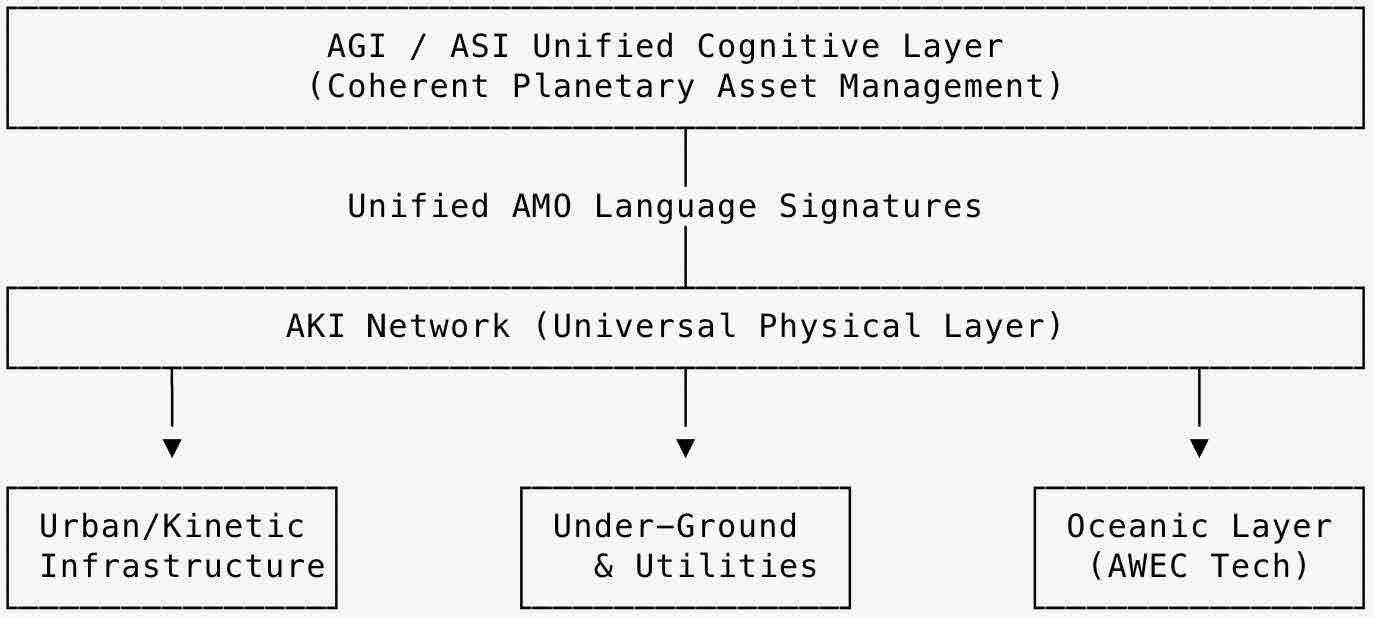
For an AGI to possess true operational competence, it must understand the physical status of its assets in real time. AKI achieves this through a unified algorithmic protocol known as the AMO Language.
Instead of translating different sensory types (barometric, acoustic, optical) into fragmented code, the AMO language translates all real-world kinetic events directly into standardized electromagnetic signatures. This creates a high-fidelity, cross-domain Active Digital Twin of any geographic location:
9. UNBIASED PHYSICAL GROUND TRUTH
Human-generated datasets carry the accumulated biases, gaps, and statistical hallucinations of digital collection methods. Data derived natively from Active Magnetic Oscillation carries none of these distortions:
“Gravity does not possess an agenda. Magnetic flux does not exhibit bias. The kinetic response of a physical mass is a direct, immutable reflection of natural law.”
By capturing pristine physical motion signatures, AKI supplies autonomous systems, robotics, and digital twin models with pure ground reality—eliminating model drift and preventing catastrophic hallucinations in critical edge operations.
10. THE MULTI-TIER AKI ARCHITECTURE
The AKI platform operates across a synchronized physical and computational hierarchy:
1. Physical Substrate (AMC / RMI)
The mechanical and magnetic foundation. Patented Active Magnetic Cradle (AMC) chambers house repelling magnetic elements that create an asymmetric, non-linear potential well, engineered for decadal durability without mechanical degradation.
2. Dynamic Waveform Phenomenon (AMO)
Active Magnetic Oscillation governs the deterministic transfer of energy packets between suspended bodies. As the system oscillates, repelling fields compress along the longitudinal axis, producing multi-harmonic spatial magnetic flux gradients.
3. Firmware HAL & Physical Ground Truth
Translates continuous magnetic vector dynamics ($B_x, B_y, B_z$) into calibrated physical telemetry. By isolating transverse flux compression from orthogonal clashing zones, this layer establishes an absolute, tamper-evident physical baseline that filters out ambient geomagnetic noise.
4. Clockless Temporal Logic & Physical Acceleration
Replaces quartz-crystal clock dependencies with the natural, deterministic cadence of the oscillating wave. By mapping spatial magnetic vectors into discrete execution frames, the physical field itself acts as an instantaneous, non-linear reservoir accelerator.
5. Distributed Mesh & Autonomous Consensus
Enables decentralized networks of autonomous nodes to achieve peer-to-peer phase synchronization across standard telemetry links—maintaining microsecond-accurate physical coordination in RF-jammed, GPS-denied, or subsea environments.
11. REAL-TIME ANOMALY DETECTION & PRECURSOR SENSING
Traditional edge monitoring systems register an event only after a macroscopic threshold has been crossed (such as an impact, a structural fracture, or a wave surge). AKI fundamentally alters the physics of detection:
Equilibrium Sensing Capabilities
- Precursor Recognition: By operating at physical equilibrium, AKI identifies microscopic phase anomalies within the kinetic baseline before macroscopic deflection occurs.
- Sub-Surface & Structural Monitoring: Subtle tectonic, seismic, oceanic, or industrial vibration shifts become visible in the magnetic flux gradient long before conventional accelerometer thresholds trigger an alarm.
- Decoupled Resilience: Because telemetry and logic are generated via electromagnetic induction, monitoring continues uninterrupted through electrical outages, cyber disruptions, and extreme conditions.
12. GLOBAL ADVANTAGE & INDUSTRIAL APPLICATIONS
The convergence of kinetic energy harvesting and embodied intelligence unlocks high-value operational capabilities across global sectors:
High-Impact Operational Domains
- Maritime & Ocean Energy: Sustained power and autonomous telemetry for subsea drones, oceanographic buoys, and wave-powered environmental monitoring platforms without maintenance cycles.
- Civil & Structural Health: Continuous, self-powered monitoring of bridges, tunnels, dams, and offshore wind turbines, tracking micro-fatigue long before macroscopic fractures appear.
- Autonomous Robotics & Locomotion: Battery-less proprioceptive sensing that provides real-time feedback on terrain resistance, payload shifts, and dynamic mechanical balance.
- Critical Infrastructure Security: Physical, unjammable intrusion and vibration sensing that operates independently of external communication grids or utility power lines.
13. PLANETARY-SCALE SENSOR DISTRIBUTION
To construct a complete digital twin, AKI sensors are deployed across diverse, remote, and extreme kinetic environments where traditional battery-powered systems fail:
Urban Areas & Infrastructure
- Smart Cities & Buildings: Embedded in floors and doors to capture human footfall data and traffic flow, converting daily human motion into localized power and utility metrics.
- Bridges & Roads: Distributed across transport networks to monitor structural health, traffic loads, and mechanical stress using the vibrations of the vehicles themselves.
Facilities & Underground Environments
- Extreme Facilities: Operating in areas of exceptionally low or high fluid velocities to map localized airflow dynamics and environmental shifts.
- Underground & Pipes: Placed along sub-surface facilities and utility piping networks to capture fluid flow, mechanical shifts, and early seismic/tectonic movements before they manifest on the surface.
The Oceanic Frontier
The ocean represents the largest unmonitored area on Earth. AKI bridges this massive gap through Active Wave Energy Converter (AWEC) technology:
- Synchronized Language: Oceanic AWEC installations utilize the exact same low-friction oscillating mechanisms and AMO signatures as terrestrial sensors.
- Subsea Autonomy: Marine deployment allows the AI to track subsea currents, temperature changes, and aquatic movement at 100% uptime without ever needing battery replacements or surface grid power.
14. THE FATAL FLAW OF NON-AKI AGI SYSTEMS
Any advanced AGI or ASI system that attempts to operate purely in the cloud—competing against an AGI system integrated with an AKI framework—is fundamentally flawed in its design.
| Attribute | Pure Digital AGI | AKI-Integrated AGI |
|---|---|---|
| Asset Coherence | Relies on delayed, fragmented, or simulated third-party APIs. | Possesses an immediate, bidirectional perception-action link to every physical asset. |
| Communication | Vulnerable to network latency, data translation loss, and power grid dropouts. | Continuous, real-time telemetry transmitted seamlessly via a native physics language. |
| Operational Reality | Blind to unexpected physical variables outside its training datasets. | Native mastery over gravity, friction, structural fatigue, and dynamic environmental change. |
Without AKI, a cloud-based AGI lacks communication and asset coherence. It cannot independently verify the true physical state of the world. An AKI-driven AGI remains authoritative because it controls both the physical data streams and the self-harvesting energy systems necessary to sustain its own intelligence across the globe.