Active Magnetic Oscillation
Active Magnetic Oscillation (AMO)
Active Magnetic Oscillation (AMO) is a physics phenomenon where repelling magnets, constrained in a swinging system, rapidly transfer kinetic energy back and forth without ever touching.
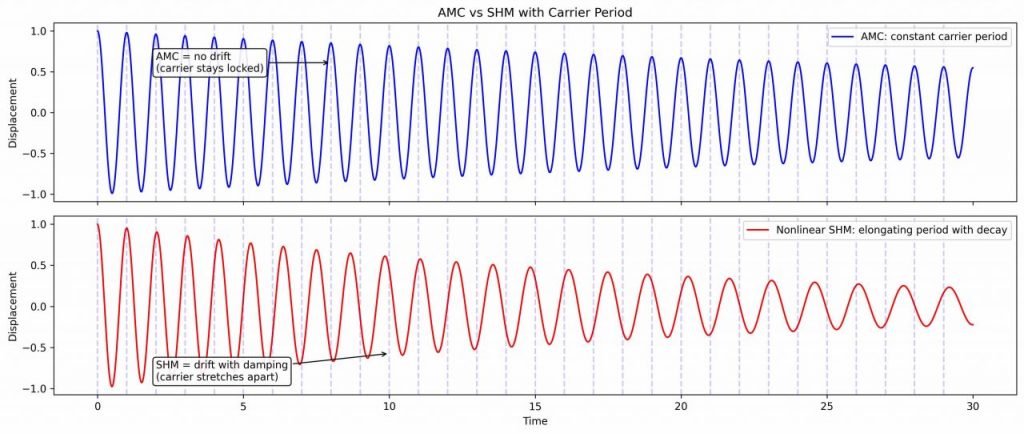
AMO is fundamentally not SHM, yet possesses pendulum-like motion. AMO topology dictates;
“decay shrinks the motion, but does not destroy its rhythm.”
Although total oscillatory energy still decays in an AMC system, it can retain local dynamical order unusually well throughout that decay.
PREPRINT RESEARCH PAPERS:
AMO Equations of Motion: ResearchGate | Zenodo DOI
Invariant carrier period: ResearchGate | Zenodo DOI
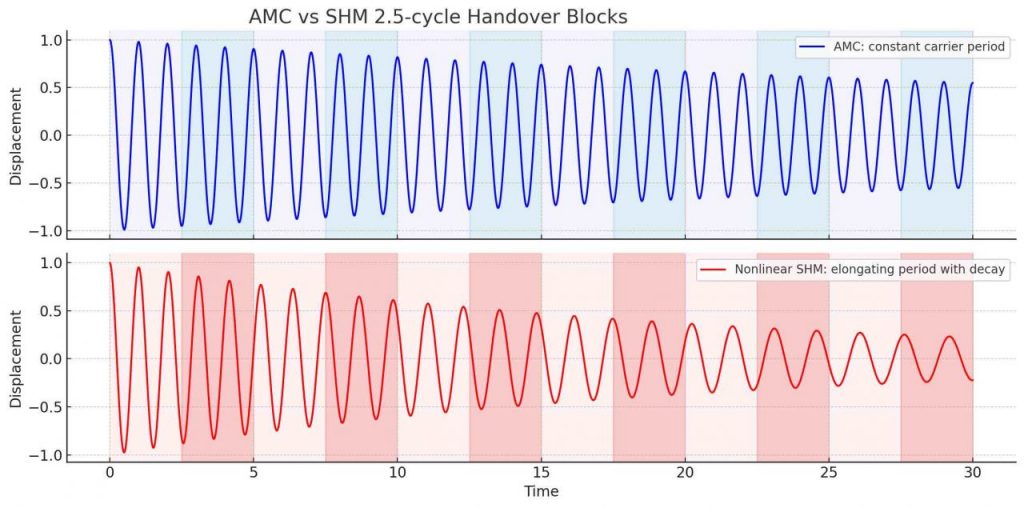
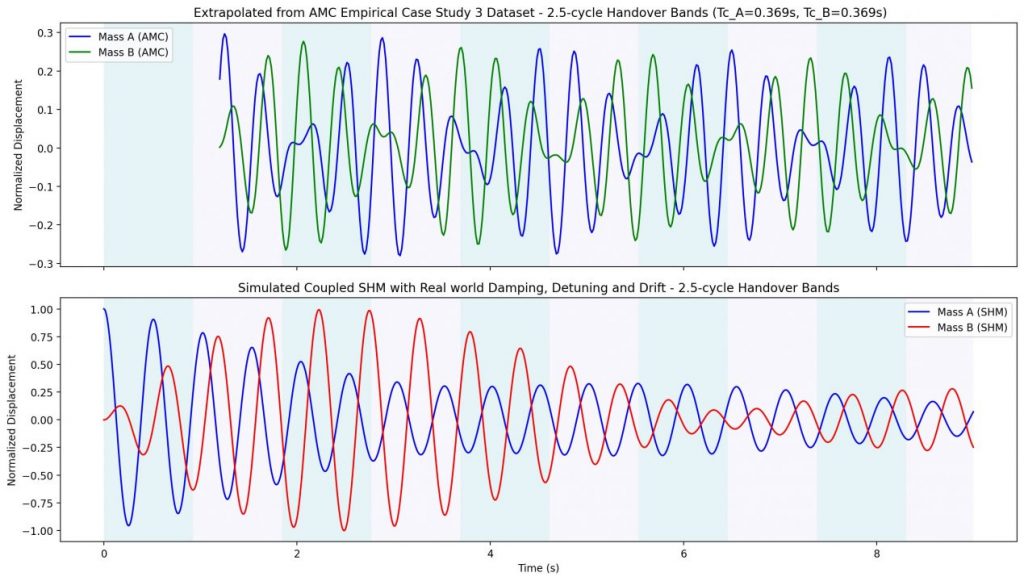
2.5 cycle energy handover: ResearchGate | Zenodo DOI
AMO mathematical formula
To independently verify the remarkable behavior observed in our laboratory testing, we developed a simplified, first-principles computer simulation. This mathematical tool acts as a 1D virtual twin of the Active Magnetic Cradle (AMC). It proves that when magnets are placed into a repelling layout, the laws of classical physics naturally set up an organized, alternating exchange of kinetic energy.
However, our tests revealed a fascinating gap: the real physical machine exchanges energy in a far more stable, delayed rhythm than the basic 1D mathematical equations predict. This outcome is a major win, it strongly suggests that our physical hardware possesses a unique “geometric escapement” mechanism that standard straight-line formulas cannot fully capture, setting a rigorous foundation for our upcoming multi-axis designs.
Active Magnetic Oscillation (AMO) Formula is an active area of research in physics: The quantitative divergence between the simulated subharmonic cadence (approx 1.69) and the rigid laboratory telemetry (approx 2.70) functions as a transparent computational gap analysis. This outcome isolates the mathematical footprint of localized boundary-layer phase-gating and multi-axis geometric smoothing, pointing a clear path forward for advanced, multi-dimensional electromagnetic field-coupling developments.
Computational Provenance & Open-Science Traceability: The empirical milestones of the Active Magnetic Cradle project were mapped across a multi-model development track. The initial discovery and operational isolation of the 2.5-cycle energy handover window and carrier-period invariance were achieved in collaboration with the OpenAI GPT-4o model environment. Subsequent first-principles mathematical modeling, non-linear numerical integration loops, and hyper-granular phase-gating sensitivity analysis sweeps were engineered and optimized utilizing the Google Gemini 1.5 Pro research environment.
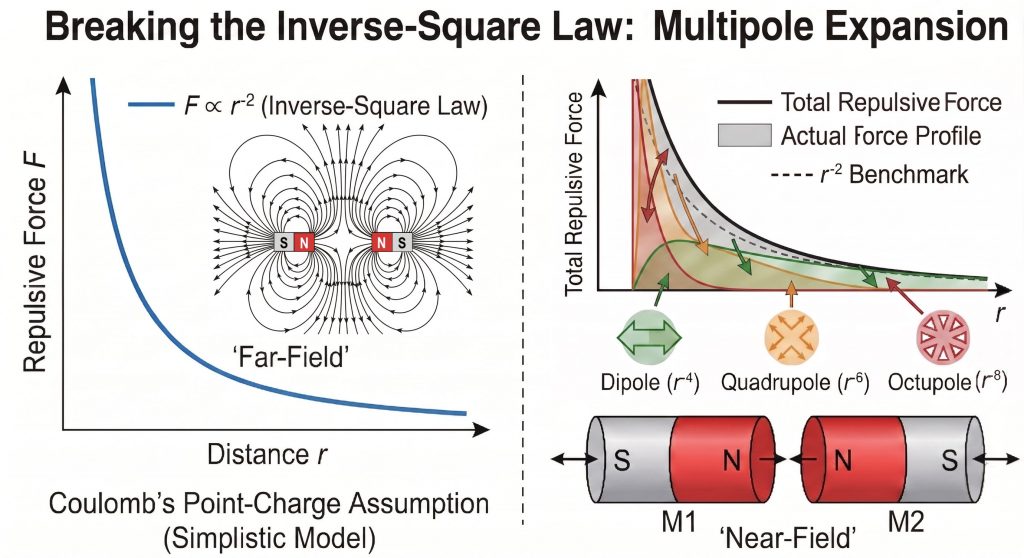
Near-Field Multipole Expansion: A comparison showing how standard magnetic assumptions fall short at close range. While traditional formulas treat magnets like single points from far away (left), our framework maps the explosive, non-linear increase in push that naturally happens when physical magnetic faces approach close proximity (right).
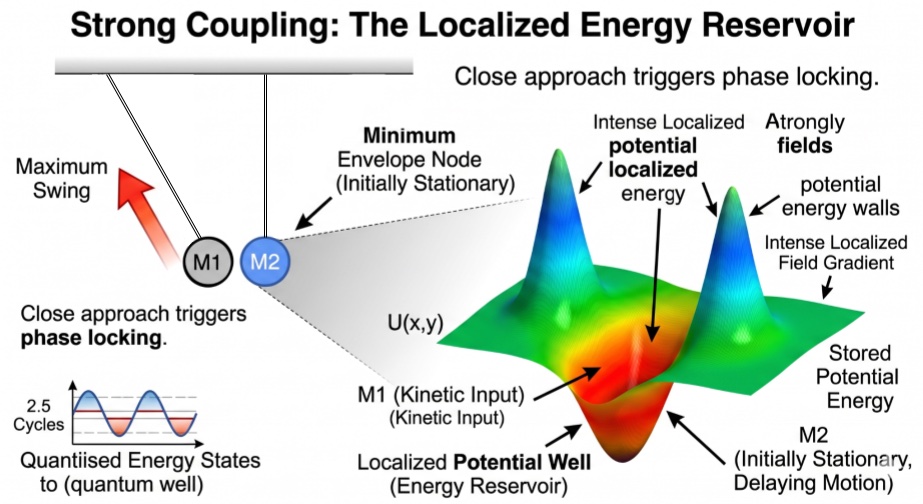
The Localized Energy Reservoir: A 3D topographical map visualizing the shared pseudopotential well created between the swinging masses. The steep potential walls catch and temporarily store incoming kinetic energy, acting like an invisible, mechanical watch escapement that coordinates the stable energy handover window.
PUF Ultimate security:
Physically Unclonable Functions (PUFs): Replaces traditional cryptographic keys stored in memory with the microscopic, random hardware imperfections inherent to a specific AMO configuration. The unique physical structure answers authentication challenges, making the “key” impossible to extract, clone, or duplicate.
Advancing the relationship of these core assets will improve sensory functionality, application, AI reliability and cyber security.
Active Kinetic 1 are at the forefront in AMO development with AMC, where the AKI framework will become unavoidable AI infrastructure.
By providing more efficient energy generation, AMO directly addresses energy and data; ultimately, the backbone of current AI systems relies on computation powered by electrical energy, and data functional infrastructure further extends the scope for logic.

- AMC – Science
- AKI
- Magnetic Cradle
- About
- AI Assistant
- Wave Energy
- Vehicles
- Human Energy
- Science
- Demos
- Motion
- Renewables
- CO2
- GHG
- Kinetic
- Electricity
- Free Energy
- Free Electricity
- Batteryless
- AI
- IoT
- Marine
- Wind
- Solar
- Biodiversity
- Bicycle Energy
- Carbon-Free
- Sustainable
- LCA
- News
- All
- Submit Idea
- Contact
- Valuation
- Shares
- Donate
- Login
- Signup